AI-powered ECG screening that runs on the device
A portable, low-cost ECG unit that captures a ten-second reading, screens it for abnormal rhythm on board in 0.13 seconds, and shows the result on screen. No internet connection, no subscription, no data leaving the device.
Built by Electuni with the CSE Discipline, Khulna University. The classifier, CAT-Net, is accepted for publication at IEEE SPICSCON 2026.
These figures come from the held-out evaluation described under Evidence below. Accuracy on the same fold is 75.95% and macro-F1 is 0.70. Macro-AUC is the headline figure because it measures ranking across every rhythm class rather than performance at a single threshold.
How it works
Three steps, all of them on the device
Record
Two leads are placed on the chest and the unit captures a ten-second reading through a TI ADS1293 analog front end.
Screen
CAT-Net, a hybrid 1D CNN and Transformer model quantised to INT8, classifies the reading in 0.13 seconds on the microcontroller itself.
Show the result
The screen indicates whether the rhythm looks normal or warrants a clinician’s review, so a health worker knows whether to refer.
The device
Built to be handled, not installed
Battery powered, no mains connection, no host computer. The enclosure holds the analog front end, the microcontroller, an OLED readout and a single button.
Evidence
Measured, then tested on people
CAT-Net was trained and evaluated on PTB-XL, a public database of clinical 12-lead ECG recordings, using a patient-stratified held-out fold so that no patient appears in both the training and test data.
- Macro-AUC
- 0.91
- Macro-F1
- 0.70
- Accuracy
- 75.95%
- Inference time
- 0.13 s, measured on the ESP32-S3
- Dataset
- PTB-XL, patient-stratified held-out fold
- Publication
- Accepted at IEEE SPICSCON 2026
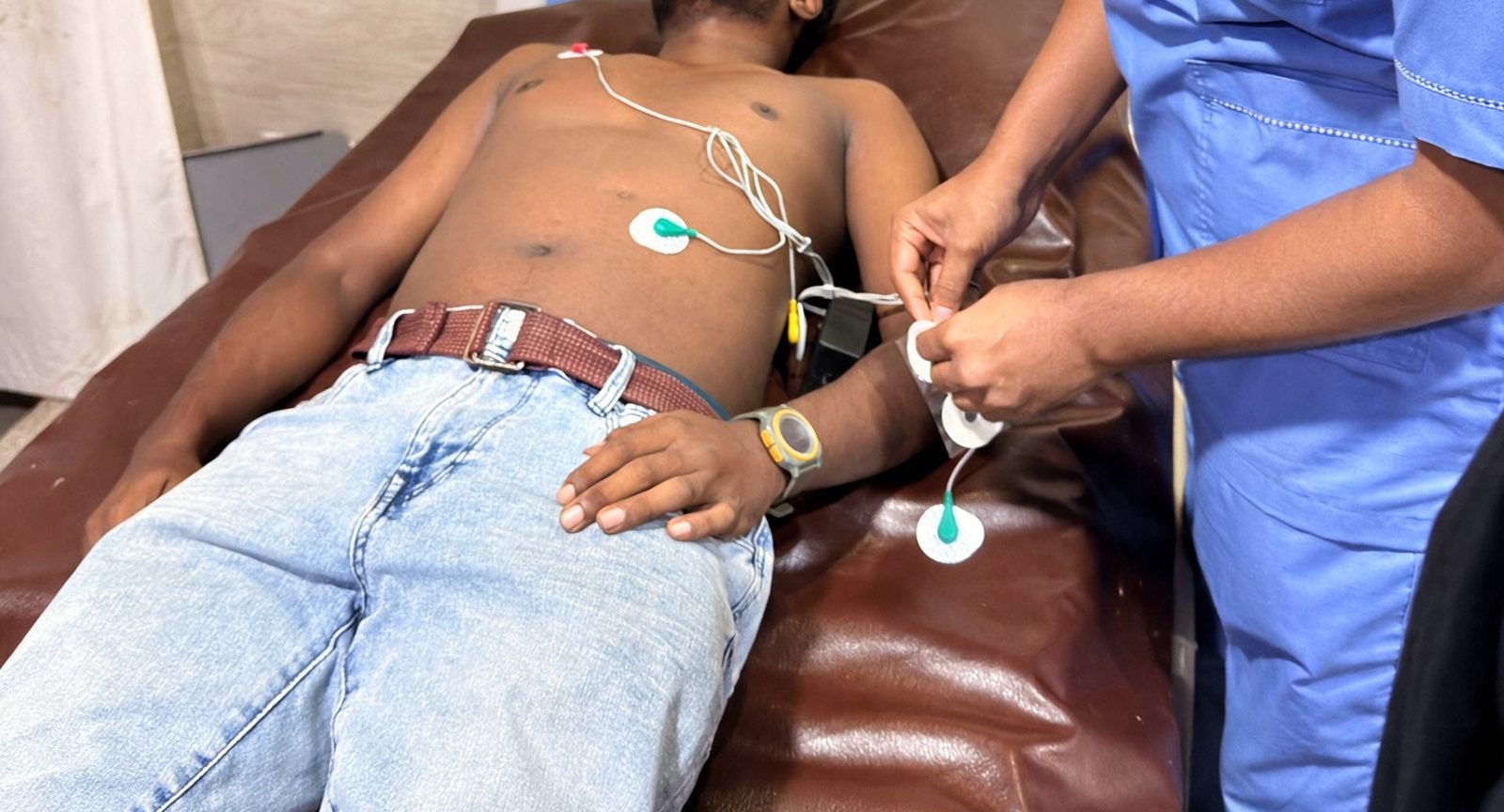
This is a research prototype. It is not a registered medical device and it does not produce a diagnosis. Clinician review and referral remain essential.
Inside
What the hardware is
- Analog front end
- TI ADS1293, two-lead acquisition with digital filtering
- Compute
- ESP32-S3, INT8 inference on device
- Model
- CAT-Net, hybrid 1D CNN and Transformer
- Footprint
- 242 KB model in flash, 107 KB tensor arena
- Interface
- On-board OLED, single button, BLE telemetry
- Power
- Battery, no mains connection required
- Board
- Custom four-layer PCB, IPC-compliant design
Where we are
What we are looking for
- Seed funding to build a twenty-unit batch for clinical piloting
- A cardiology partner for prospective validation against a reference ECG
- Guidance on the DGDA medical device registration pathway
- Pilot sites in rural and upazila health facilities